



Pneumatics · Directional Control Valves
Pneumatically Actuated Directional Control Valves – Air-Piloted 3/2, 5/2 & 5/3 Way Valves
Pneumatically actuated directional control valves switch solely via pilot air – without a solenoid coil, without electrical control at the valve itself. STASTO supplies the complete range: 3/2 way valves with spring or air return, 5/2 way valves in impulse or spring-return versions, and 5/3 way valves with spring-centered mid-position – in the compact K series as well as in standardized ISO 5599/1 design.
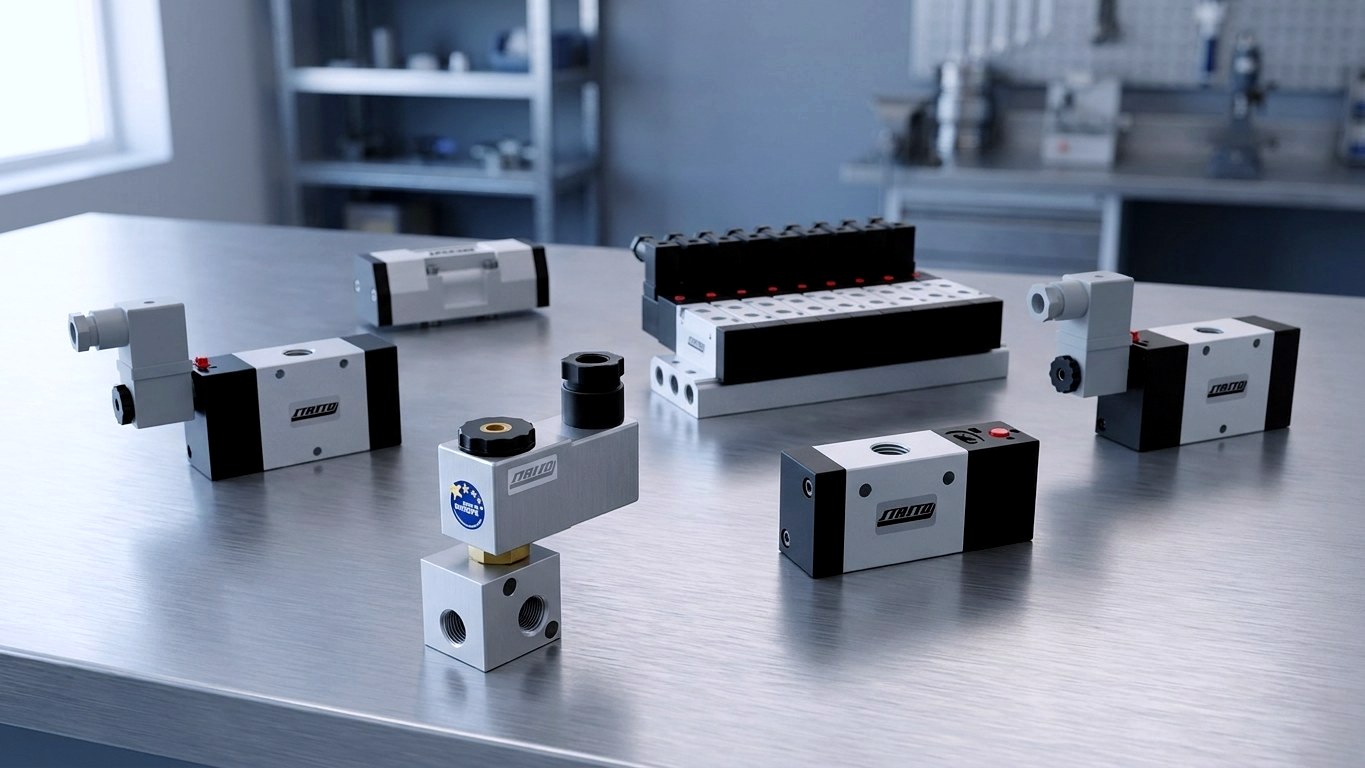
Control Without Power at the Valve
Your Advantages
Why choose air-piloted directional control valves from STASTO
Pneumatically actuated directional control valves build the entire control chain on compressed air – with the same function schematics as a solenoid valve, but without electrics at the installation site.
No electrics on the valve
Switching takes place purely via pneumatic pilot signals. This allows a control chain to be built entirely on compressed air – for example, where electrical actuation at the installation site is undesirable or structurally complex. Whether a series is approved for hazardous areas depends on the specific variant, and we're happy to clarify this on a per-item basis.
Three function types from one series
The 3/2, 5/2, and 5/3 within the K series come from the same modular system with a uniform port pattern and identical 16 mm connector width. This simplifies spare parts stocking, mounting, and battery assembly – even in mixed operation with the electrically pilot-operated sister series K3.W, K5.W, K6.W, and K9.W.
Verified technical specifications
All specifications are taken from the product data: pressure ranges of 1…9 bar (pneumatic/pneumatic), 3.1…9 bar (pneumatic/spring), and 1.5…10 bar for the ISO series PP111. Deviating values for individual variants are listed in the respective product datasheet.
Battery mounting including accessories
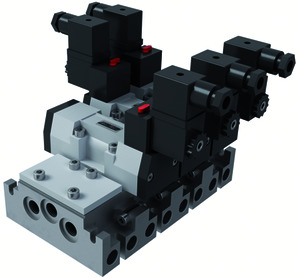
For the K series, KME series battery manifold plates are available for 5 to 13 valves – with pressure and exhaust port sizes of 1/4" or 3/8", anodized aluminum, matching valve sizes 1/8" and 1/4". We also stock blanking plates, O-ring sets, and matching silencers.
Guide
Pneumatic or electric pilot control – how do I choose correctly?
Both designs switch the same function patterns. The difference lies solely in the control signal: on the solenoid valve, a coil generates the pilot air, while on the pneumatically actuated directional valve, the pilot signal comes from a control line. Within Series K, both approaches can be combined.
Control signal and application logic
- Electrically piloted
- Where a PLC already provides direct control, electric pilot control is faster to integrate – the coil generates the pilot air.
- Pneumatically actuated
- If the signal is already pneumatic or a de-energized solution is required, pneumatic actuation is the simpler and often more robust option.
- Mixed operation possible
- Valves with solenoid coil (K3.W, K5.W) and pneumatically actuated valves (K3.P, K5.P) fit the same mounting plates.
- Remote actuation
- The valve sits close to the actuator while the signal source can be located anywhere – short working lines, shorter switching times.
Reset behavior and response to signal loss
- Pneumatic/spring
- Monostable: The valve automatically returns to its initial position when the control signal is removed (K3.P, K5.P1, PP110).
- Pneumatic/pneumatic
- Bistable impulse valve: It holds the last switched position until the opposing signal arrives (K5.P2, PP111).
- Differential piston
- Series K5.DP with pressure range 0.8…9 bar for applications with only one control signal.
- Spring-centered mid-position
- 5/3 variants move to a defined mid-position without a signal: blocked, exhausted, or pressurized.
Size and design
- 1/8"
- DN 6 mm, flow rate around 690 Nl/min for the K series – compact installation.
- 1/4"
- DN 8 mm, flow rate around 1,300 Nl/min for the K series.
- 1/2"
- DN 14 mm, flow rate up to 4,000 Nl/min – power class for large actuators.
- ISO 5599/1
- Size 1 (DN 8 mm) and size 2 (DN 13 mm), interchangeable regardless of manufacturer.
Function diagrams
3/2, 5/2 and 5/3 Differences – Functional Overview
3/2 controls one direction of action, 5/2 controls two – and 5/3 adds a third, defined neutral position.
| 3/2 | 5/2 | 5/3 | |
|---|---|---|---|
| Ports | 1 supply, 1 working port, 1 exhaust | 1 supply, 2 working ports, 2 exhaust | same as 5/2, plus a defined center position |
| Typical Application | Single-acting cylinders, vacuum suction cups, shut-off function | Double-acting cylinders, rotary actuators | Positioning, intermediate stop, controlled venting |
| Return / Center Position | NC, NO or as pulse version NC/NO | Spring return (monostable) or pulse (bistable) | Spring-centered: blocked, exhausted or pressurized |
| STASTO series | Series K3.P | Series K5.P1, K5.P2, K5.DP, PP110, PP111 | Series K5.P, PP112 |
| Pressure range | 3.1…9 bar (spring return) or 1…9 bar (double pneumatic) | 3.1…9 bar (spring return), 1…9 bar (impulse), 1.5…10 bar (PP111) | 3…9 bar (Series K), 3.2…10 bar (PP112) |
Product Range
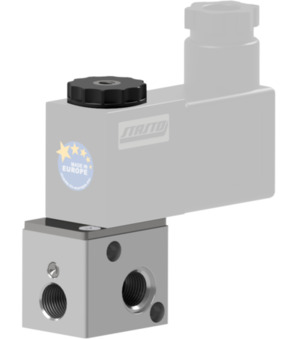
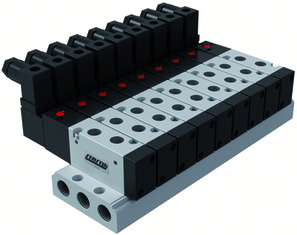
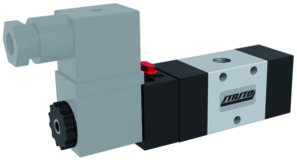
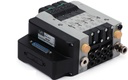
Pneumatically Actuated Directional Control Valve Series
Choose the series based on function, port size, and desired return method. All values listed are catalog specifications for the respective series; complete data can be found on the product pages.
Applications
Where air-piloted directional control valves excel
A pneumatically actuated directional control valve is the natural choice whenever the switching signal is already available as compressed air, or when no electrics should be run to the actuator by design.
Purely pneumatic control chains
Hand lever, roller lever, or push-button valves provide the signal, while the pneumatically actuated directional control valve handles the power stage for the cylinder. No wiring, no voltage supply required in the field.
Pilot control of large actuators
A small pilot signal switches a high-flow valve; the 1/2" versions in the K series achieve up to 4,000 Nl/min.
Remote Actuation via Pilot Line
The valve sits close to the actuator, while the signal source can be located at any distance. Short pilot lines mean faster switching times and lower air consumption.
Fail-Safe Behavior on Signal Loss
Spring return (K3.P, K5.P1, PP110) returns to a defined home position, while impulse valves (K5.P2, PP111) hold the last position. The 5/3 variants also allow for a defined mid-position.
Special Media Requirements
For oxygen applications, we supply oil- and grease-free versions such as K32P1614-0F. We clarify suitability, approvals, and operating conditions on an application-specific basis.
Series Machine Building with Valve Manifolds
Battery mounting on KME manifold plates saves on piping and creates a central compressed air supply for up to 13 valves.
Service
Availability, packaging and delivery
A large part of the series shown here is listed as a standard item; actual availability and lead time depend on variant and quantity and are shown to you item-specific in the shop or in the quotation. Special versions – such as oil- and grease-free variants for oxygen applications like K32P1614-0F – are available on request.

Quote per item and variant
We show availability and price on an item-specific basis – request via the contact form or directly from our sales team.
Pre-Assembled Units
Valve, mounting plate, and accessories are assembled on request into a ready-to-install unit.
European Distribution
We supply customers in Germany, Austria, Switzerland, and other European markets through the STASTO national subsidiaries.
Special Versions
Oil- and grease-free versions as well as custom configurations are available on request; suitability and approval are clarified based on the application.
Selection guide
Three steps to the right series
Here's how to quickly narrow down the right pneumatically actuated directional valve.
Determine function type and return
Single-acting (3/2) or double-acting (5/2 / 5/3) – and then the behavior on signal loss: spring return, impulse function, or spring-centered mid-position.
Size flow rate and port connection
Cylinder volume and required piston speed determine the DN and port size: 1/8" ≈ 690 Nl/min, 1/4" ≈ 1,300 Nl/min, 1/2" ≈ 4,000 Nl/min for the K series.
Choose design and request quote
Compact Series K for space-saving installation, ISO 5599/1 (PP110/PP111/PP112) for standardized interchangeability. Our sales team supports you with special versions and approvals.
FAQ
FAQ on pneumatically actuated directional control valves
Answers on pilot pressure, spring return, center positions and mountability.
What is a pneumatically actuated directional control valve?
A pneumatically actuated directional control valve is a directional valve whose spool is shifted not by a solenoid coil but by a pneumatic pilot signal. The signal acts through a separate pilot port on the end face of the spool; no electrical power is required at the valve itself.
What is the difference between pneumatic/spring and pneumatic/pneumatic actuation?
With spring return, the valve automatically returns to its initial position once the pilot signal is removed, whereas with double pneumatic actuation it acts as an impulse (bistable) valve and stays in the last commanded position. Examples are K32P1614 or K52P1014 for spring return and K52P2014 for the impulse version.
What pilot pressure do I need?
This depends on the series: double pneumatically actuated versions in the K Series operate in the range of 1-9 bar, spring-return versions from 3.1 bar. For the ISO series, 1.5-10 bar applies to PP111 and 4-10 bar to PP110; the values valid for each specific variant are listed in the product datasheet.
What center positions are available for 5/3 way valves?
There are three center positions: closed center (the actuator holds its position), exhaust center (the actuator is depressurized and free to move) and pressure center (both chambers pressurized). All variants of the K5.P series are spring-centered, while the ISO series PP112 offers closed center and exhaust center.
What is the difference between a 3/2 and a 5/2 way valve?
A 3/2 way valve controls one direction of action and is suited to single-acting cylinders, vacuum suction cups or shut-off functions, while a 5/2 way valve controls two directions of action and is used for double-acting cylinders and rotary actuators. The 3/2 has one working port, the 5/2 has two working ports and two exhaust ports.
Can I mix pneumatically and electrically actuated valves?
Yes. Within the K Series, the pneumatically actuated K3.P and K5.P series share the same port pattern as the solenoid pilot-operated K5., K6. and K9. series, allowing them to be mounted together on KME series manifold sub-bases.
Are the valves suitable for hazardous (ATEX) areas?
This depends on the variant and must be checked per item. Since there is no electrical connection at the valve itself, pneumatic actuation is often an approach for power-free control chains – we're happy to clarify the specific suitability and required certifications with you on an application-specific basis.
What does ISO 5599/1 mean for directional control valves?
ISO 5599/1 is the standard for the mounting interface of directional control valves and makes valves from different manufacturers interchangeable. STASTO offers sizes ISO 1 (DN 8 mm) and ISO 2 (DN 13 mm) in the PP110, PP111, and PP112 series.
Goes well with
Related categories
Complementary components and sister series for pneumatic valve technology.
Get started
Find the right series or request a sizing
From the compact 3/2 way valve in the K Series to the ISO 5599/1 valve in size 2: order directly from our online shop or have us size your control chain.