



Directional Control Valves – Mechanically & Manually Operated
Mechanically Actuated Directional Control Valves – Roller Lever, Cam, Push-Button & Foot Valves
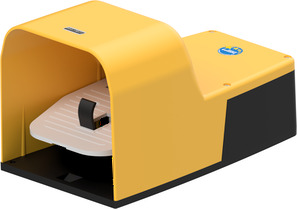
When a motion needs to be switched not electrically but directly by the workpiece, the slide, or the operator's hand, mechanically and manually actuated directional control valves are the most robust solution. A roller lever valve detects the end position of a cylinder without sensors, wiring or control electronics – purely pneumatic, low-wear and unaffected by dust, chips and moisture. STASTO offers the full spectrum of actuation types in one system: roller and roller lever valves (VCLL, VCLR, MR/PM141, MS/PM142), cam valves (VCMS, MA/PM140, MV), push-button valves (VCMT, PGI/PM144, PF/PM145, PFF/PM147), lever and toggle valves (VCML, SR/PM146, MV46, MV48), foot valves (PM122), and hand-operated slide and rotary spool valves (214 series, MV26, HDV) – available as 3/2, 5/2 and 5/3 directional control valves.
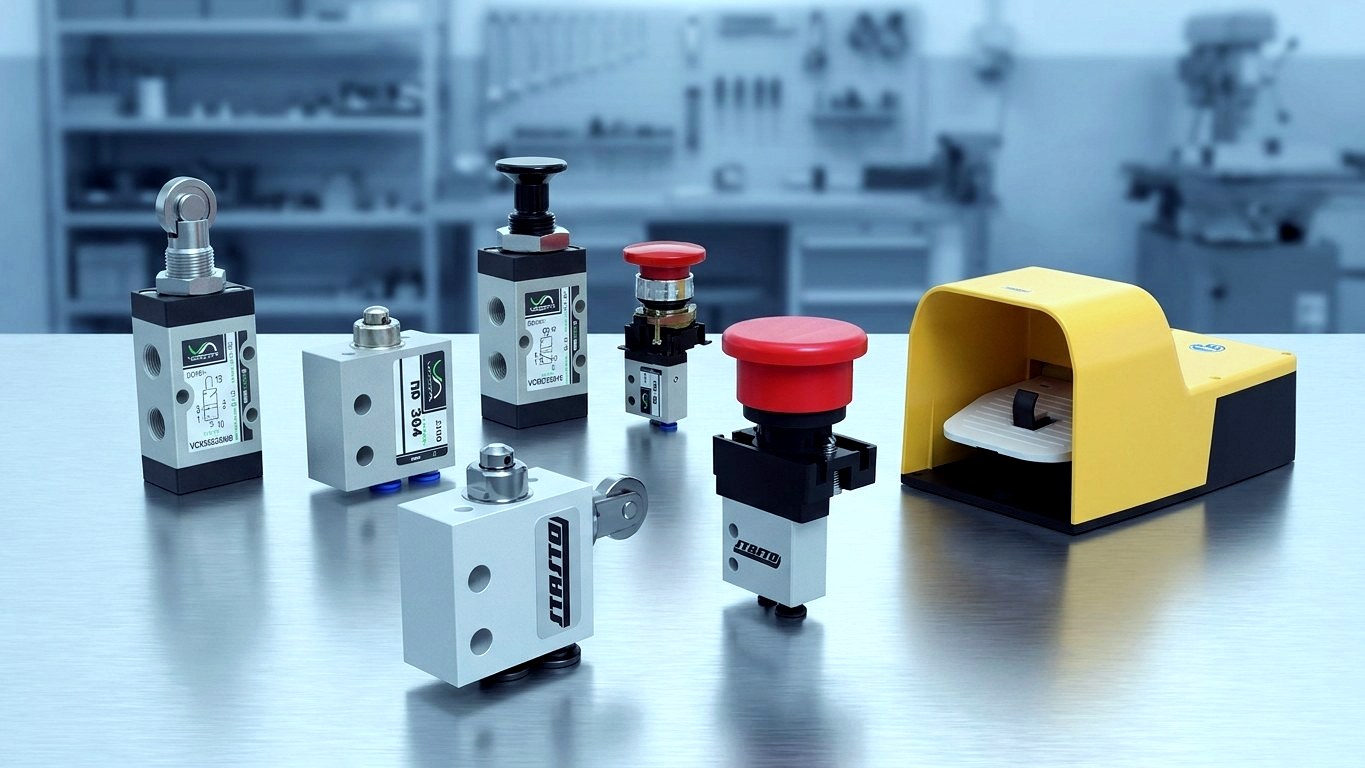
Overview of Actuation Types
Your benefits
Why mechanically actuated directional control valves from STASTO
Roller, roller lever, cam, pushbutton, lever, toggle, foot pedal and hand slide – bundled into one system with the technical data that truly matter for sizing.
All five actuator types from a single source
Roller, roller lever, cam, plunger, mushroom head, lever, toggle, rocker lever, foot pedal, hand slide, and rotary slide: you compare all actuator types within one system instead of across multiple manufacturers. This simplifies spare parts sourcing and retrofit, since size and function can often be matched one-to-one.
Technical data sufficient for proper sizing
For every variant you'll find nominal size, flow rate, pressure range, port size, function (NC/NO), and actuation force at 6 bar. Example: a roller valve VCLL326M8 switches at 22 N at 6 bar, while a miniature valve MR314 switches at just 12 N – a difference that determines the permissible approach force on the cam.
From miniature to high-flow
The series cover 60 Nl/min for pilot lines and signal tapping as well as 1,080 Nl/min for direct cylinder actuation. Small series work with 4 mm or 8 mm push-in fittings and a nominal size of 2.5 mm, larger ones with 1/8", 1/4", or 1/2" and nominal sizes up to 9 mm.
Guidance from automation engineers
You get sizing support on switching sequence, actuator geometry, and approach angle, not just a part number. On request, we assemble valve, fitting, tubing, and cylinder as a matched unit.
Guide
Selecting the Right Mechanically Actuated Directional Control Valve
Five selection criteria reliably lead to the right variant – from valve function through actuation type to flow rate, pressure range, and actuation force.
Determine Function and Actuation Type
- 3/2-way valve
- Controls single-acting cylinders and relays signals. NC = normally closed, NO = normally open.
- 5/2-way valve
- Controls double-acting cylinders – available as roller valve VCLL/VCLR, cam valve VCMS, pushbutton valve VCMT, and foot valve PM122, among others.
- 5/3-way valve with locked center position
- Holds the piston position in the mid-position, e.g. VCML53618 and VCML53614.
- Roller or trip roller
- A fixed roller actuates in both approach directions, while a trip roller (Series MS/PM142) actuates in only one direction and deflects in the opposite direction.
- Cam, pushbutton, or foot actuation
- Cam actuation for defined cam profiles, plunger/pushbutton actuation for manual operation, foot actuation for hands-free work.
- Return: spring or detent
- Spring-return valves reset automatically (momentary operation, signal tapping), while detented versions such as VCMT32018, MV26, or Series 214 hold their state.
Check flow, pressure and actuation force
- Signal and pilot lines
- 60 Nl/min at DN 2.5 mm is sufficient – series MR, MS, MA, PGI, PF, PFF, SR.
- Direct cylinder actuation
- 650 Nl/min (DN 6, 1/8") or 1,080 Nl/min (DN 8, 1/4"); an undersized valve noticeably increases stroke time.
- Pressure range
- Most of the listed series are rated for 0…10 bar; MV46 and MV48 operate up to 15 bar, the HDV rotary valve series up to 12 bar, and the PM122 foot valve in the 3…10 bar range.
- Actuation force at 6 bar
- 12 N for the miniature series, 22 N for VCLL/VCLR, 35 N or 50–64 N for VCMS depending on size. Force increases with pressure.
- Mounting position and overtravel
- Note the cam ramp angle and overtravel: the roller must not be pushed beyond the permissible stroke.
- Panel mounting
- Panel-mount versions are available for control panels, such as MV314.
Comparison
3/2, 5/2 and 5/3 in Direct Comparison
The valve function determines which cylinders and control chains you can switch – the actuation type can then be freely selected.
| 3/2 | 5/2 | 5/3 | |
|---|---|---|---|
| Typical Application | Single-acting cylinders, signal pickup | Double-acting cylinders | Double-acting cylinders with intermediate stop |
| Rest position | NC (closed) or NO (open) | Two stable switching positions | Mid-position closed (piston holds) |
| Example series | VCLL, VCLR, VCMS, VCMT, MR/PM141, Series 214 | VCLL, VCLR, VCMS, VCMT, VCML, PM122 | VCML (e.g. VCML53618, VCML53614) |
| Actuation types | Roller, roller lever, cam, pushbutton, hand slide | Roller, cam, pushbutton, lever, foot pedal | Hand lever, detented or spring-return |
| Flow rate (typical) | 60 to 650 Nl/min | 650 to 1,080 Nl/min | 650/1,080 Nl/min |
Product Range
Actuation types and categories
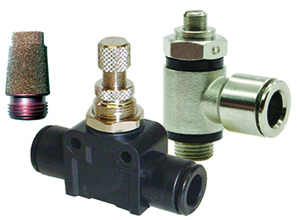
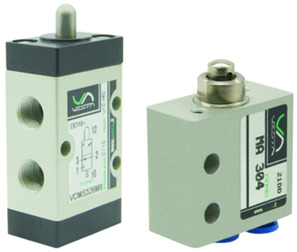
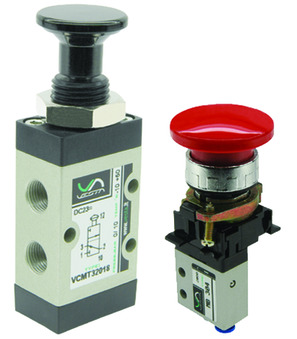
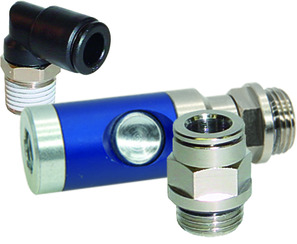
Six product groups cover the spectrum from limit sensing to control stations and setup and shut-off functions.
Applications
Typical Applications
From sensorless end-position sensing to emergency exhaust: where mechanically and manually actuated directional control valves show their strengths.
End-position sensing without electronic sensors
A roller lever valve reports the reached cylinder position directly via pneumatic signal and triggers the next step. In environments with cutting fluid, metal dust, or weld spatter, this is often more robust than an electrical solution – and needs neither control cabinet space nor cable runs.
Cycle and cam control systems
Cam-operated valves read control cams and cam tracks. Matching approach angle, stroke, and actuation force is essential: the VCMS series requires 35 N or 50–64 N at 6 bar depending on size, while the MA/PM140 miniature series needs only 12 N.
Manual control stations and setup stations
Push-button, toggle, and hand-lever valves form operator stations that work without a controller: clamping and releasing, feed on/off, tool change. Detented versions hold their state, while spring-return versions reset automatically on release.
Hands-free operation on press and clamping fixtures
Foot valves of the PM122 series trigger the working stroke while the operator guides the workpiece. For safety-related two-hand operation, the two-hand safety block from the pneumatic control elements range is available; the safety assessment is carried out on a plant-specific basis.
Emergency venting, setup, and service functions
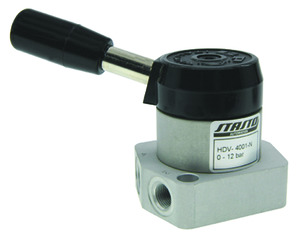
Hand slide and rotary slide valves isolate plant sections from the compressed air network during setup or vent them in a defined manner. The 4/3 HDV versions with vented mid-position are a common choice here.
Control chains without electrics
Where a purely pneumatic control chain is desired, combine mechanically actuated directional control valves with double check valves, time-delay elements, and sight indicators. Details on materials, media compatibility, and Ex suitability depend on the variant and are confirmed on request.
Procurement
Procurement without detours
Common variants of the listed series can be scheduled at short notice; actual availability and lead time depend on the variant and series and will be confirmed for each specific item. Special versions, deviating actuating elements or connection patterns are clarified on request. For recurring requirements we set up framework orders and call-off quantities so that maintenance and assembly are reliably supplied.
Quotation with technical review
Every inquiry is checked against the application – function, actuation geometry and connection pattern are matched before the quotation is issued.
Datasheets per series
Datasheets and dimensional drawings for the VCLL, VCMS, VCMT, VCML, PM122, HDV and other series are provided on request.
Operating conditions depend on variant
Specifications on temperature range, media compatibility, materials and Ex suitability depend on the variant – please inquire, we will confirm them based on the respective datasheet.
Spare parts and actuation accessories
Cam springs, roller levers and other actuating elements for retrofit and maintenance available on request.
Process
Three steps to the right valve
From application description to a matched unit of valve, fitting, tubing, and cylinder.
Describe the application
Tell us the valve function (3/2, 5/2, 5/3), actuator type, port size, and required flow rate – or simply the motion that needs to be switched.
Sizing and Quotation
Our automation engineers review switching sequence, actuation geometry, approach angle and actuating force, and provide datasheets along with an item-specific quotation.
Delivery and Replenishment
Availability and lead time are confirmed on an item-specific basis. For recurring requirements, we set up blanket orders and call-off quantities.
FAQ
Frequently asked questions about mechanically actuated directional valves
Answers on roller lever valves, actuation types, valve functions and port sizes.
What is a roller lever valve in pneumatics?
A roller lever valve is a mechanically actuated directional valve whose switching position is changed by contacting a roller – usually via a cylinder, slide or workpiece. It operates purely pneumatically and replaces an electrical limit switch and its wiring in many cycle control systems.
What's the difference between roller, cam and one-way trip roller valves?
The roller valve switches in both directions when actuated, the one-way trip roller valve only in one approach direction, and the cam valve is actuated via a plunger driven by a control cam. The one-way trip roller valve (e.g. Serie MS/PM142) yields in the opposite direction, while the cam valve requires a defined lift profile.
3/2 or 5/2 – which valve do I need?
3/2 directional valves are suitable for single-acting cylinders and control signals, 5/2 directional valves for double-acting cylinders. Both functions are available in several actuation types, such as VCLL and VCLR as roller valves, VCMS as a cam valve and VCMT as a plunger valve.
What port sizes are available?
Depending on the series, 4 mm and 8 mm push-in fittings, M5 as well as female and male threads in 1/8", 1/4" and up to 1/2" are available. The smaller series operate with a nominal bore of 2.5 mm, the larger ones with nominal bores up to 9 mm.
What is the required actuation force?
The datasheet values refer to 6 bar: a roller valve VCLL326M8 switches at 22 N, a miniature valve MR314 already at 12 N. Cam valves of the VCMS series require 35 N or 50–64 N depending on size; the actuating force increases with operating pressure.
When should I choose a detent version instead of a spring-return version?
Detent valves hold the switched position and are suited for setup and shut-off functions, while spring-return valves automatically snap back when released, matching momentary operation and signal pickups. Detent examples include VCMT32018, MV26 and the 214 series.
What pressure range do the series cover?
Most of the listed series are rated for 0…10 bar; MV46 and MV48 operate up to 15 bar, the rotary spool series HDV up to 12 bar, and the foot valve PM122 in the range of 3…10 bar. The exact values depend on the variant and are confirmed via the datasheet.
Are panel-mount versions available?
Yes, panel-mount versions for control panels and operator panels are available, such as MV314. Refer to the series-specific datasheet for the connection pattern, dimensions and permissible mounting conditions, or request them from us.
Also relevant
Related Categories
Complement the actuation level with logic elements, actuators and connection technology for the complete pneumatic control chain.
Next step
Looking for a roller lever, cam, plunger or foot valve?
Choose directly from our range or describe your application – we'll work out actuator type, function and flow together.